LANSING, Mich. (Michigan News Source) – Nearly six years after the 2020 election, a volunteer team examining Detroit absentee voting records says it has uncovered what it believes is a major inconsistency.
After individually reviewing the absentee ballot envelopes produced through FOIA and comparing them against November and December 2020 Qualified Voter File (QVF) snapshots, researchers say they identified a discrepancy involving 26,901 of Detroit’s 174,384 certified absentee votes. The researchers say their figure was derived through the record-by-record reconciliation process rather than by simply subtracting the number of envelopes produced through FOIA from the certified absentee vote total.
MORE NEWS: Michigan’s Rural Veterinarian Shortage Prompts Nearly $1.4 Million State Investment
The finding comes from a months-long review of election records obtained through the Freedom of Information Act by independent election researcher Yehuda Miller and analyzed by more than 100 well-trained volunteers working with The Gateway Pundit and the Check My Vote project. In May, we covered their investigation into Detroit’s 2020 election records, including early findings they said pointed to irregularities in absentee ballot documentation.
According to the investigators, Detroit officially reported counting 174,384 absentee ballots during the 2020 general election. However, the team says it received only 155,487 absentee ballot envelopes from the city as part of its FOIA production, leading researchers to conclude that thousands of ballots cannot be matched to their required envelopes.
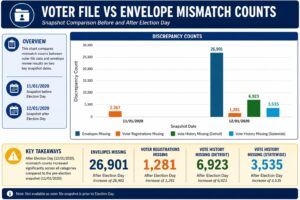

Graphics credit: The Gateway Pundit
Why the ballot envelope matters.
Under Michigan law in effect during the 2020 election, absentee ballots were required to be returned in a signed ballot envelope. That envelope contained identifying information used to verify the voter and process the ballot, including the voter’s signature and other required information. A ballot returned without a properly signed envelope should not have been counted. In addition, the unique number assigned to the ballot inside the envelope was required to match the ballot number recorded on the outside of the envelope. Without an envelope, there is no signature to verify and no ballot number to match against the ballot inside. In other words, the key records used to verify the ballot and document its chain of custody would be missing.
Michigan News Source contacted Benson’s office to ask why there were so many ballot envelopes missing from the FOIA request and why ballots without envelopes were counted. Her office did not respond to our request for comment.
The investigation isn’t over.
The envelope findings might just be the appetizer, as the investigators say the main course is still coming. The group says its next phase will compare signatures on absentee ballot applications with signatures on ballot envelopes. Researchers also say they have already identified what they describe as numerous irregularities, including missing voter signatures and dates, incorrect addresses,
misspelled names, missing clerk time stamps, envelopes stamped before voters supposedly signed them, and mailing addresses outside Detroit that they believe deserve additional scrutiny.
MORE NEWS: El-Sayed, AOC Take Campaign to Trump Country as Michigan Senate Race Heats Up
The group’s conclusions have not been independently verified by state or local election officials, as the review is still in its early stages. Researchers plan to continue examining more than 170,000 absentee ballot applications before turning their findings over to authorities.